
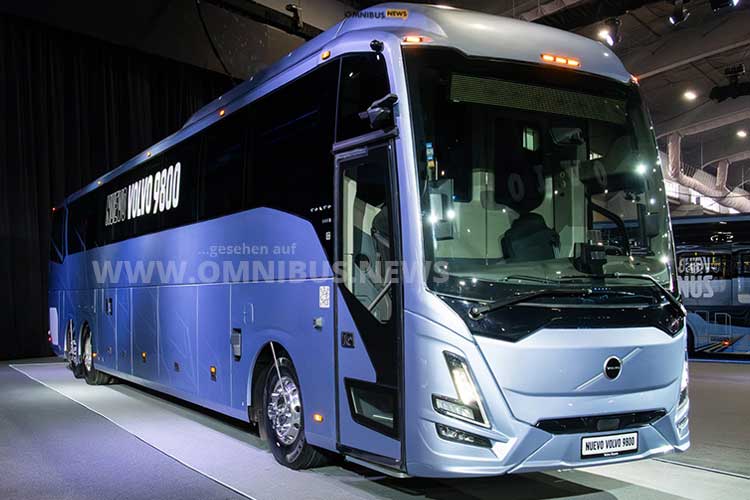
Auf der mexikanischen Expo Foro Movilidad hat Volvo Buses die erneuerte 9800er Baureihe vorgestellt. Foto: Volvo Buses
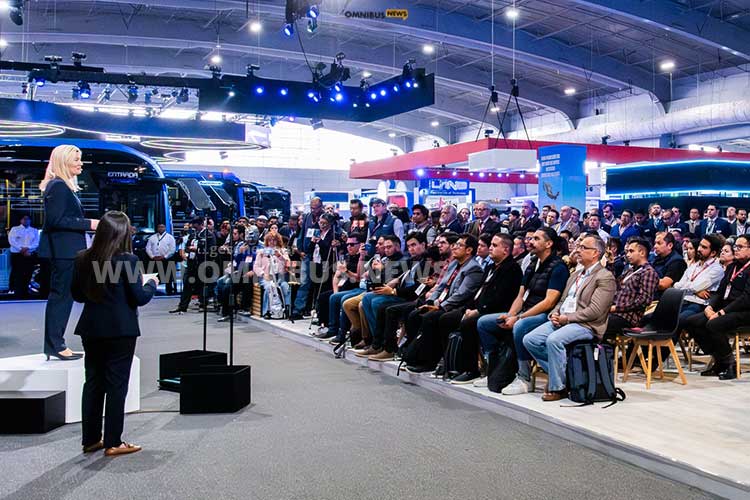
Anna Westerberg, die seit Februar 2021 als Präsidentin Volvo Buses die Bussparte leitet, war zur Premiere des neuen 9800 nach Mexiko gereist. Foto: Volvo Buses
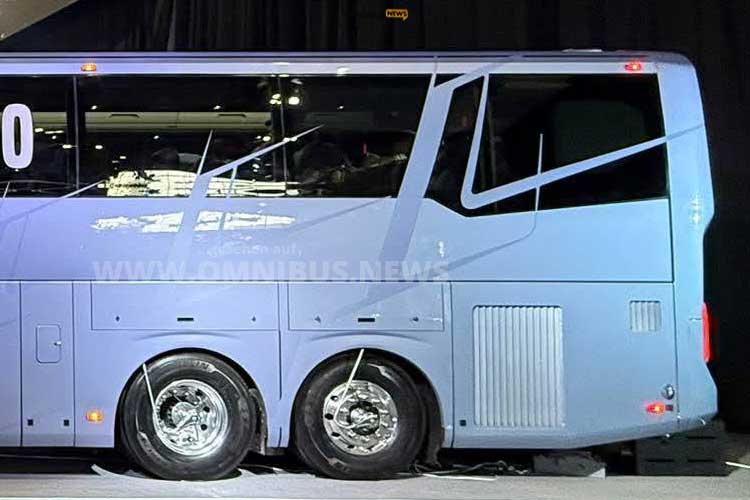
Die Seitengrafik nimmt die Formensprache des Volvo Doppeldecker-Reisebusses auf. Foto: Volvo Buses
english text below – Seit Volvo Buses ankündigte, die Reisebusse für den europäischen Markt in Mexiko in der von 28 Jahren errichteten Busfabrik in Tultitlán (im Großraum von Mexico City) zu produzieren, blickt die Busbranche auch gelegentlich über den großen Teich. Das mexikanische Werk hat rund 50.000 m² Produktionsfläche, rund 2.000 Mitarbeiter fertigen hier komplette Reisebusse der Baureihen 9700, 9800 und 9800DD. Auch BRT- und Stadtbusse (z. B. 7300BRT, 7800 Electric) sowie Bus-Fahrgestelle (wie B8R, B11R, B13R) werden in Mexiko gefertigt. Anlässlich der Expo Foro Movilidad 2026 stellte Volvo Buses die nächste Generation der 9800-Baureihe vor.
Die Expo Foro Movilidad ist nicht nur eine Busmesse, sondern auch eine Branchenkonferenz für Bus- und Personenverkehr in Lateinamerika. Sie gilt als eines der wichtigsten Treffen der Busbranche, in diesem Jahr waren über 100 Aussteller auf den 24.000 qm Ausstellungsfläche dabei. Und auch Anna Westerberg, die seit Februar 2021 als Präsidentin Volvo Buses die Bussparte leitet, war zur Premiere des neuen 9800 nach Mexiko gereist. Im Rahmen der Vorstellung der neuen 9800er Baureihe teilte der schwedische Bushersteller mit, in diesem Jahr mit 30 Einheiten den Export von Reisebussen für Europa zu starten, ab 2027 sollen es aber schon 200 Einheiten pro Jahr werden, so Rafael Kisel, Präsident der Volvo Group Mexiko.
Anna Westerberg, globale Präsidentin von Volvo Buses, präzisierte die Aussführungen und merkte an, dass die exportierten Reisebusse zunächst nur in Märkten wie Italien, Frankreich, Großbritannien und den nordischen Ländern vertrieben werden würden. Der neue 9800 werde speziell für den mexikanischen Markt gebaut. Vor zehn Jahren hatte Volvo Buses die 9800-Baureihe für Südamerika und insbesondere das Langstreckengeschäft vorgestellt, bislang seien kanpp 5.000 Einheiten produziert worden, wie es anlässlich der Vorstellung der neuen Baureihe seitens Rafael Kisel hieß. Das dynamischere Design an Front und Heck, das Anleihen beim Doppeldecker genommen hat, folge dem Leitsatz form follows function und führe – zusammen mit dem Spiegelersatzsystem – zu einem um 11% verbesserten Luftwiderstandswert, so Kisel.
Und weil die neue Baureihe im Vergleich zum Vorgänger 650 Kilogramm leichter sei, was auf eine neue Hinterachse konnte in Summe so auch der Kraftstoffverbrauch um bis zu 4 % gesenkt werden. Gebaut werde die neue 9800er Baureihe in der Mexiko-Breite von 2,6 Metern mit 13,2 (4×2), 14 und 15 Metern (beide 6×2) Länge. 46 bis 52 Fahrgäste finden in dem ebenfalls überarbeiteten Fahrgastraum je nach Länge und Ausstattung einen Sitzplatz. Der neue 9800 für Mexiko wird von einem Dieselmotor angetrieben, der 13-Liter-Euro-6-Motor ist in zwei Leistungsstufen (460 PS und 500 PS) erhältlich. Für eine verbesserte Umweltverträglichkeit könne er auch mit HVO betrieben werden.
Für die beiden 6×2-Varianten werde ein neues elektrohydraulisches Lenksystem an der Hinterachse verbaut, was auch zur Gewichtsersparnis und Wirtschaftlichkeit beitrage, denn der Wartungsaufwand sei deutlich geringer, so Kisel. Welcher Omnibus sei besser als der von Volvo wurde bei der Premiere gefragt? Nur der neue Reisebus von Volvo, so die kurze und knappe Antwort. Die insbesondere auf Effizienz getrimmte neue Generation würden jetzt jeden Kilometer mehr denn je zu einem entspannten Erlebnis für Fahrer und Fahrgäste machen, so Kisel. Die Produktion der neuen Generation werde in den nächsten Monaten starten, versicherte der mexikanische Buschef von Volvo Buses. (VolvoBuses/PM/Sr)
Volvo Buses unveiled its new 9800 series at the Mexican Expo Foro Movilidad. Photo: Volvo Buses
Anna Westerberg, who has headed the bus division as President of Volvo Buses since February 2021, traveled to Mexico for the premiere of the new 9800. Photo: Volvo Buses
The side graphic adopts the design language of the Volvo double-decker coach. Photo: Volvo Buses
Since Volvo Buses announced it would be producing coaches for the European market in Mexico at its 28-year-old bus factory in Tultitlán (near Mexico City), the bus industry has occasionally taken a keen interest in the company. The Mexican plant has approximately 50,000 m² of production space, and around 2,000 employees manufacture complete coaches of the 9700, 9800, and 9800DD series. BRT and city buses (e.g., 7300BRT, 7800 Electric) as well as bus chassis (such as the B8R, B11R, and B13R) are also produced in Mexico. At Expo Foro Movilidad 2026, Volvo Buses unveiled the next generation of the 9800 series.
Der Beitrag Volvo stellt neuen 9800 vor erschien zuerst auf omnibus.news.
Keine Antworten