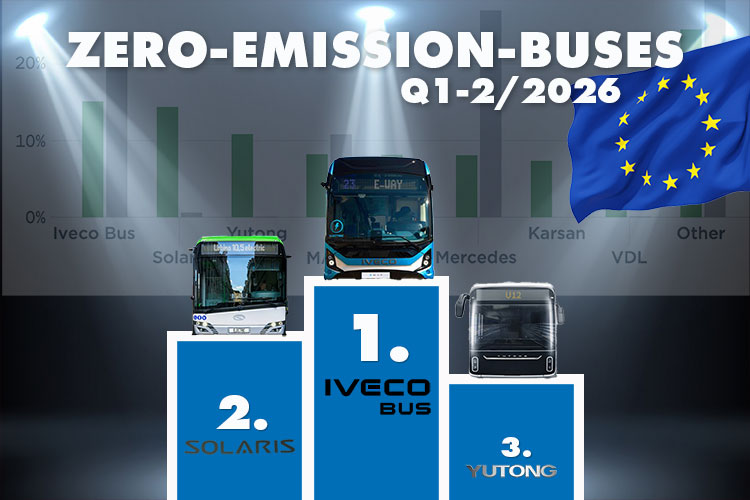
Iveco Bus führt bei den Neuzulassungen in Europa im Segment der Elektrobusse nach Q1-2/26. Foto: Solaris, Schreiber, Yutong, ACEA; Montage: omnibus.news
english text below – Wow, bislang waren es Elektrobusse der Marke Yutong, die das Siegertreppchen der europaweiten Neuzulassungen in ihrem Segment jahrelang für sich beanspruchten. Nun kickt Iveco Bus den chinesischen Wettbewerber nach Q1-2/26 vom 1. Platz! Und auch Solaris ist wieder dabei, Platz 2 geht an den polnischen Bushersteller unter dem Dach der spanischen CAF-Gruppe. Immer noch Platz 3 für Yutong, wie die Zahlen des Europäischen Automobilherstellerverbandes (ACEA), in dem sich die 16 größten europäischen Auto-, Lkw-, Transporter- und Bushersteller Europas zusammengeschlossen haben, mitteilt. Man darf gespannt sein, ob und wie sich das Ranking zum Jahresende verändern wird.
Fakt ist: Yutong hat sich von einem Nischenanbieter zu einem der wichtigsten Akteure auf dem europäischen Elektrobusmarkt entwickelt. Bei den Neuzulassungen 2024 war das Unternehmen mit 1.092 Fahrzeugen und rund 14 % Marktanteil der größte Hersteller von Elektrostadtbussen in Europa. Auch 2025 konnte Yutong mit mit 1.801 neuen Elektrobussen und rund 15 % Marktanteil den 1. Platz erfolgreich verteidigen. Nur in 2026 sieht es noch nicht nach Platz 1 aus. Aber: Noch sind es sechs Monate bis zum Jahresende. Der Erfolg von Yutong basiert vor allem auf einem guten Preis-Leistungs-Verhältnis, technischer Reife und einer wachsenden europäischen Serviceorganisation.
Gleichzeitig dürfte der Wettbewerb in den kommenden Jahren intensiver werden, da europäische Hersteller ihre Modellpalette ausbauen und politische sowie regulatorische Rahmenbedingungen zunehmend an Bedeutung gewinnen. Aber für 2026 ist das Rennen noch offen… Zurück zur Statistik: So wie sich Iveco Bus (15%) und Solaris (14,3%) nahezu ein Kopf-an-Kopf-Rennen um Platz 1 und 2 liefern, so sieht es auch bei den Plätzen 4, 5 und 6 aus: MAN (8,2%) schlägt BYD (8,1%) und Mercedes-Benz (8,1%) hauchdünn. Genau in der Mitte zwischen Platz 2 und 4 rangiert nach den ersten sechs Monaten des Jahres 2026 nun Yutong mit 10,8% Marktanteil.
Mit 7,4% Marktanteil folgt der türkische Bushersteller Karsan vor VDL mit 3% Marktanteil im ersten Halbjahr 2026. Iveco Bus (15,0 % bei emissionsfreien Omnibussen, 19,8 % bei konventionellen) ist der einzige Hersteller mit einer starken Marktposition in beiden Segmenten. Solaris ist nahezu vollständig auf emissionsfreie Busse fokussiert. MAN (8,2 % emissionsfrei,10,7 % konventionell) verfügt über ein vergleichsweise ausgewogenes Portfolio. Mercedes bleibt Marktführer bei Diesel- und Gasbussen, baut aber seine Position im Elektrosegment weiter aus. BYD und Karsan konzentrieren sich vollständig auf batterieelektrische Busse. VDL spielt als Bushersteller aus den Niederlanden bzw. Belgien im betrachteten Zeitraum leider eine deutlich kleinere Rolle als in früheren Jahren.
Während chinesische Hersteller wie Yutong und BYD ihre Marktanteile nahezu ausschließlich mit emissionsfreien Fahrzeugen erzielen, verfolgen europäische Bushersteller überwiegend eine Doppelstrategie und bedienen sowohl den konventionellen als auch den elektrischen Markt. Kurz noch ein Blick auf Deutschland, bevor auch hier Details zum Ranking demnächst hier auf omnibus.news folgen: Deutschland meldete für Q1-2/25 insgesamt 835 Elektrobusse, in Q1-2/26 sind es nur noch 567 Stromer…Es geht auch anders: Allein in Italien verkaufte Iveco Bus in Q2/26 über 700 Elektrobusse! In Europa wurden in Q1–Q2/26 insgesamt 22.600 neue Omnibusse zugelassen, 6.400 waren lokal emissinsfreie. (ACEA/omnibus.news/PM/Sr)
Wow! Jahrelang standen Elektrobusse von Yutong bei den europaweiten Neuzulassungen in ihrem Segment unangefochten auf dem Siegertreppchen. Nach dem ersten Halbjahr 2026 verdrängt jedoch Iveco Bus den chinesischen Wettbewerber von Platz 1. Auch Solaris ist zurück in der Spitzengruppe: Der polnische Hersteller unter dem Dach der spanischen CAF-Gruppe belegt Rang 2. Yutong fällt auf Platz 3 zurück. Das zeigen die aktuellen Zahlen des Europäischen Automobilherstellerverbandes (ACEA), in dem sich die 16 größten europäischen Hersteller von Pkw, Transportern, Lkw und Omnibussen zusammengeschlossen haben. Man darf gespannt sein, ob und wie sich das Ranking bis zum Jahresende noch verändern wird.
Fakt ist: Yutong hat sich in den vergangenen Jahren von einem Nischenanbieter zu einem der wichtigsten Akteure auf dem europäischen Elektrobusmarkt entwickelt. Bei den Neuzulassungen 2024 war das Unternehmen mit 1.092 Fahrzeugen und rund 14 Prozent Marktanteil der größte Hersteller von Elektrostadtbussen in Europa, wie auf omnibus.news in den entsprechenden Meldungen zu lesen war. Auch 2025 verteidigte Yutong mit 1.801 neu zugelassenen Elektrobussen und einem Marktanteil von rund 15 Prozent erfolgreich Platz 1. Nur 2026 sieht es bislang nicht nach einem erneuten Spitzenplatz aus. Allerdings sind bis zum Jahresende noch sechs Monate Zeit.
Der Erfolg von Yutong basiert vor allem auf einem attraktiven Preis-Leistungs-Verhältnis, technischer Reife und einer kontinuierlich wachsenden europäischen Serviceorganisation. Gleichzeitig dürfte sich der Wettbewerb in den kommenden Jahren weiter verschärfen. Europäische Hersteller bauen ihre Modellpaletten konsequent aus, während politische und regulatorische Rahmenbedingungen zunehmend an Bedeutung gewinnen. Für 2026 ist das Rennen jedenfalls noch völlig offen. Zurück zur Statistik: Während sich Iveco Bus (15,0 Prozent) und Solaris (14,3 Prozent) derzeit ein Kopf-an-Kopf-Rennen um die Plätze 1 und 2 liefern, geht es auch dahinter ausgesprochen eng zu.
MAN (8,2 Prozent) liegt nur hauchdünn vor BYD (8,1 Prozent) und Mercedes-Benz (8,1 Prozent). Dazwischen rangiert Yutong nach den ersten sechs Monaten des Jahres 2026 mit einem Marktanteil von 10,8 Prozent auf Platz 3. Mit 7,4 Prozent Marktanteil folgt der türkische Hersteller Karsan vor VDL, das im ersten Halbjahr 2026 auf 3,0 Prozent kommt. Iveco Bus (15,0 Prozent bei emissionsfreien Omnibussen, 19,8 Prozent bei konventionellen Fahrzeugen) ist der einzige Hersteller mit einer starken Marktposition in beiden Segmenten. Solaris konzentriert sich nahezu vollständig auf emissionsfreie Busse. MAN (8,2 Prozent emissionsfrei, 10,7 Prozent konventionell) verfügt über ein vergleichsweise ausgewogenes Portfolio.
Mercedes-Benz bleibt Marktführer bei Diesel- und Gasbussen, baut seine Position im Elektrosegment jedoch kontinuierlich aus. BYD und Karsan konzentrieren sich vollständig auf batterieelektrische Busse. VDL spielt als Hersteller aus den Niederlanden im betrachteten Zeitraum dagegen nur noch eine deutlich kleinere Rolle als in früheren Jahren. Während chinesische Hersteller wie Yutong und BYD ihre Marktanteile nahezu ausschließlich mit emissionsfreien Fahrzeugen erzielen, verfolgen die europäischen Hersteller überwiegend eine Doppelstrategie und bedienen sowohl den konventionellen als auch den elektrischen Markt.
Zum Schluss noch ein kurzer Blick nach Deutschland, bevor demnächst auf omnibus.news weitere Details zum nationalen Ranking folgen: In Deutschland wurden im ersten Halbjahr 2025 insgesamt 835 Elektrobusse neu zugelassen, im ersten Halbjahr 2026 sind es nur noch 567. Dass es auch anders geht, zeigt Italien: Allein dort setzte Iveco Bus im zweiten Quartal 2026 mehr als 700 Elektrobusse ab. Europaweit wurden im ersten Halbjahr 2026 insgesamt 22.600 neue Omnibusse zugelassen. Davon entfielen rund 6.400 auf lokal emissionsfreie Fahrzeuge. (ACEA/omnibus.news/PM/Sr)
Iveco Bus leads European new registrations in the electric bus segment for the first two quarters of 2026. Photo: Solaris, Schreiber, Yutong, ACEA; montage: omnibus.news
For years, Yutong electric buses dominated the top spot for new registrations in their segment across Europe. Now, Iveco Bus has knocked the Chinese competitor out of first place during the first half of 2026! Solaris is also back in the mix, with second place going to the Polish bus manufacturer—part of the Spanish CAF Group. Yutong holds onto third place, according to figures from the European Automobile Manufacturers’ Association (ACEA), which represents Europe’s 16 largest manufacturers of cars, trucks, vans, and buses. It will be interesting to see if and how the rankings shift by the end of the year.
The fact is, Yutong has evolved from a niche player into a key force in the European electric bus market. In 2024, the company was the leading manufacturer of electric city buses in Europe, recording 1,092 new registrations and a market share of around 14%. It successfully defended the top spot in 2025 as well, with 1,801 new electric buses and a market share of approximately 15%. While a first-place finish doesn’t look likely for 2026 just yet, there are still six months left in the year. Yutong’s success is driven primarily by a strong price-performance ratio, technical maturity, and an expanding European service network.
At the same time, competition is expected to intensify in the coming years as European manufacturers expand their model ranges and political and regulatory frameworks become increasingly significant. However, the race for 2026 remains wide open… Returning to the statistics: just as Iveco Bus (15%) and Solaris (14.3%) are engaged in a neck-and-neck battle for first and second place, a similar situation exists regarding fourth, fifth, and sixth place: MAN (8.2%) narrowly edges out BYD (8.1%) and Mercedes-Benz (8.1%). Yutong ranks exactly between second and fourth place after the first six months of 2026, holding a 10.8% market share.
Turkish bus manufacturer Karsan follows with a 7.4% market share, ahead of VDL, which holds 3% for the first half of 2026. Iveco Bus (15.0% for zero-emission buses, 19.8% for conventional ones) is the only manufacturer with a strong market position in both segments. Solaris focuses almost exclusively on zero-emission buses. MAN (8.2% zero-emission, 10.7% conventional) maintains a comparatively balanced portfolio. Mercedes remains the market leader for diesel and gas buses but continues to expand its position in the electric segment. BYD and Karsan focus entirely on battery-electric buses.
Unfortunately, during the period under review, VDL—a bus manufacturer based in the Netherlands and Belgium—plays a significantly smaller role than in previous years. While Chinese manufacturers such as Yutong and BYD generate their market share almost exclusively through zero-emission vehicles, European bus manufacturers predominantly pursue a dual strategy, serving both the conventional and electric markets. A quick look at Germany before detailed ranking figures appear here on omnibus.news soon: Germany reported a total of 835 electric buses for the first half of 2025, but that figure dropped to just 567 electric units in the first half of 2026.
Things can look very different elsewhere: in Italy alone, Iveco Bus sold over 700 electric buses in the second quarter of 2026! Across Europe, a total of 22,600 new buses were registered in the first half of 2026, 6,400 of which were zero-emission vehicles. (ACEA/omnibus.news/PR/Sr) Wow! For years, Yutong’s electric buses held the top spot unchallenged in the European new registration rankings for their segment. However, following the first half of 2026, Iveco Bus has displaced the Chinese competitor from first place. Solaris has also returned to the leading group: the Polish manufacturer—part of the Spanish CAF Group—has secured second place, while Yutong has slipped to third.
These figures come from the European Automobile Manufacturers’ Association (ACEA), which represents the 16 largest European manufacturers of passenger cars, vans, trucks, and buses. It will be interesting to see if and how the rankings shift before the end of the year. The fact is, Yutong has evolved from a niche player into one of the key players in the European electric bus market over the past few years. In terms of new registrations in 2024, the company was the largest manufacturer of electric city buses in Europe, with 1,092 vehicles and a market share of around 14 percent—as previously reported on omnibus.news. Yutong successfully defended the top spot in 2025 as well, with 1,801 newly registered electric buses and a market share of around 15 percent.
However, the outlook for 2026 does not currently point to another first-place finish—though there are still six months left in the year. Yutong’s success is driven primarily by an attractive price-performance ratio, technical maturity, and a continuously expanding European service network. At the same time competition is likely to intensify further in the coming years. European manufacturers are consistently expanding their model ranges, while political and regulatory frameworks are becoming increasingly important. In any case, the race for 2026 remains wide open. Returning to the statistics: while Iveco Bus (15.0 percent) and Solaris (14.3 percent) are currently neck and neck for first and second place, the competition is also extremely tight further down the rankings.
MAN (8.2 percent) is just a whisker ahead of BYD (8.1 percent) and Mercedes-Benz (8.1 percent). Yutong ranks third, with a market share of 10.8 percent for the first six months of 2026. Turkish manufacturer Karsan follows with a 7.4 percent market share, ahead of VDL, which holds 3.0 percent for the first half of 2026. Iveco Bus (15.0 percent for zero-emission buses, 19.8 percent for conventional vehicles) is the only manufacturer with a strong market position in both segments. Solaris focuses almost exclusively on zero-emission buses. MAN (8.2 percent zero-emission, 10.7 percent conventional) boasts a comparatively balanced portfolio. Mercedes-Benz remains the market leader for diesel and gas buses but is steadily expanding its position in the electric segment.
BYD and Karsan focus entirely on battery-electric buses. In contrast, Dutch manufacturer VDL plays a significantly smaller role during the period under review than in previous years. While Chinese manufacturers such as Yutong and BYD generate their market share almost exclusively through zero-emission vehicles, European manufacturers predominantly pursue a dual strategy, serving both the conventional and electric markets. Finally, a brief look at Germany before further details on the national ranking appear on omnibus.news: A total of 835 electric buses were newly registered in Germany in the first half of 2025, whereas the figure dropped to just 567 in the first half of 2026.
Italy demonstrates that things can be done differently: in the second quarter of 2026 alone, Iveco Bus sold more than 700 electric buses there. Across Europe, a total of 22,600 new buses were registered in the first half of 2026, with around 6,400 of these being zero-emission vehicles. (ACEA/omnibus.news/PM/Sr)
Der Beitrag Iveco vor Solaris & Yutong erschien zuerst auf omnibus.news.
Keine Antworten